Why Management by Design
Management is the constraint.
Growing companies hit predictable barriers. Management by Design exists to help you break through them with a system built for clarity, consistency and endurance — the operating system that coordinates decisions, enables learning and strengthens middle management.
The wall
Crossing the Dunbar Chasm
Around 50–150 employees, organizations hit a structural wall. Communication slows. Alignment fades. Managers struggle. Executives get dragged into day-to-day issues.
This is the point where informal leadership stops working. Management by Design gives you the structure to cross it.
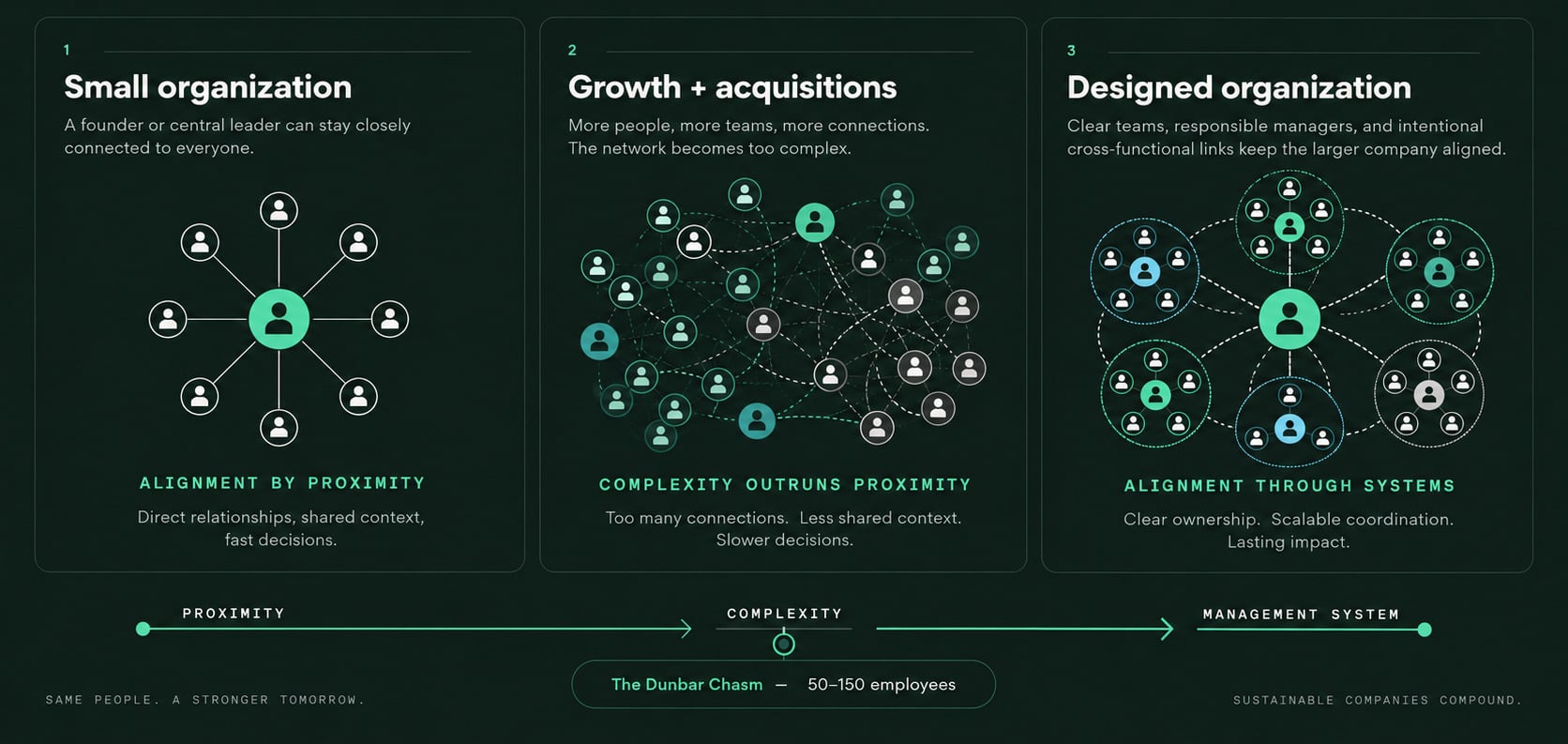
What starts as proximity must eventually become design. Cross the chasm without it, and the first thing you lose is control of where your time goes.
The patterns we see
Four symptoms, one root cause
Leadership bandwidth vanishes
What's really happeningInformal processes break at scale; decisions bottleneck at the top.
You can't find enough "A players"
What's really happeningRoles are fuzzy, talent is inconsistent, and good people burn out quickly.
Constant customer firefighting
What's really happeningA reactive culture, missing feedback loops and weak operational rhythms leave no room for strategy or momentum.
Agility turns to drag
What's really happeningStrategy stalls; hardworking teams are rarely in sync.
The difference
The standard training model vs. Management by Design
Both set out to make your managers better. Only one of them is still running a year later.
The standard training model
- One-off
- Individual rather than team-based
- Not reinforced
- Not connected to a playbook
- Not cross-functional
- Not tied to real work
Management by Design
- Shared standards
- Cross-functional collaboration
- Monthly reinforcement
- Real-time feedback loops
- Executive visibility
- A living Management & Leadership Handbook
- A system that grows with your company
Training changes what your managers know. A system changes what they do — it strengthens your managers, aligns your teams, and gives leadership clearer sight lines into what's happening on the ground.
Management is the central nervous system of your organization.
Management by Design is one of five interconnected systems in the Persistence Management System. It's the brain — coordinating decisions, enabling learning and strengthening the layer between strategy and execution.